
Open-cell and closed-cell foam
Spray Foam Insulation in Cincinnati, OH
Dense closed-cell where damp masonry and cold meet the house, lighter open-cell where air sealing and quiet matter most.
- Free in-person estimates
- Written quote with material, thickness and R-value for each area
- Leaks, damp framing and old wiring flagged before anything is covered
Choosing the Foam Comes First
Spray foam insulation does the most good in a Cincinnati house where air, heat and moisture all move at once: crawl space walls, rim joists, attic rooflines, knee walls and walls opened during a remodel. The foam is sprayed as a liquid, swells into every crack and hardens in place, so a single layer both insulates and air seals. In a river valley where the average July dew point runs about 64F and winter brings around 23 inches of snow, stopping that air movement matters as much as the R-value printed on the quote. We spray two foams, and deciding which one goes where is the first call on every job.
Closed cell vs open cell
Closed-cell foam cures hard and dense. HomeGuide rates it at roughly R-5 to R-7 per inch, and at typical thickness it slows water vapor and will not soak up water. It also stiffens the surface it bonds to. Open-cell foam is soft and spongy, expands far more, and rates around R-3.5 to R-3.7 per inch. It is an excellent air seal and sound damper, but vapor passes through it, so it needs a design that handles moisture.
In Cincinnati those traits point closed-cell at the damp and below-grade spots: crawl space walls, basement walls, rim joists, and the underside of a roof deck over a vaulted ceiling with no room for vent channels. Open-cell suits interior walls, floors between heated rooms, above-grade wall cavities in a gut remodel, and some attic rooflines where the moisture plan is handled.
Code targets and thickness
Ohio's residential energy table lists R-49 for ceilings and R-20, or R-13 plus R-5 continuous, for wood-frame walls in both Zone 4A (Hamilton and Clermont counties) and Zone 5A (Butler and Warren). Basement and crawl space walls carry R-10 continuous or R-13 in the cavity, and floors over unheated space call for R-19 in Zone 4 and R-30 in Zone 5. Those numbers set how thick the foam has to be. Closed-cell can reach a wall target in a few inches of a 2x4 bay; open-cell needs the full depth. We write the planned thickness and the resulting R-value side by side on the quote.
Where foam goes in a Cincinnati house
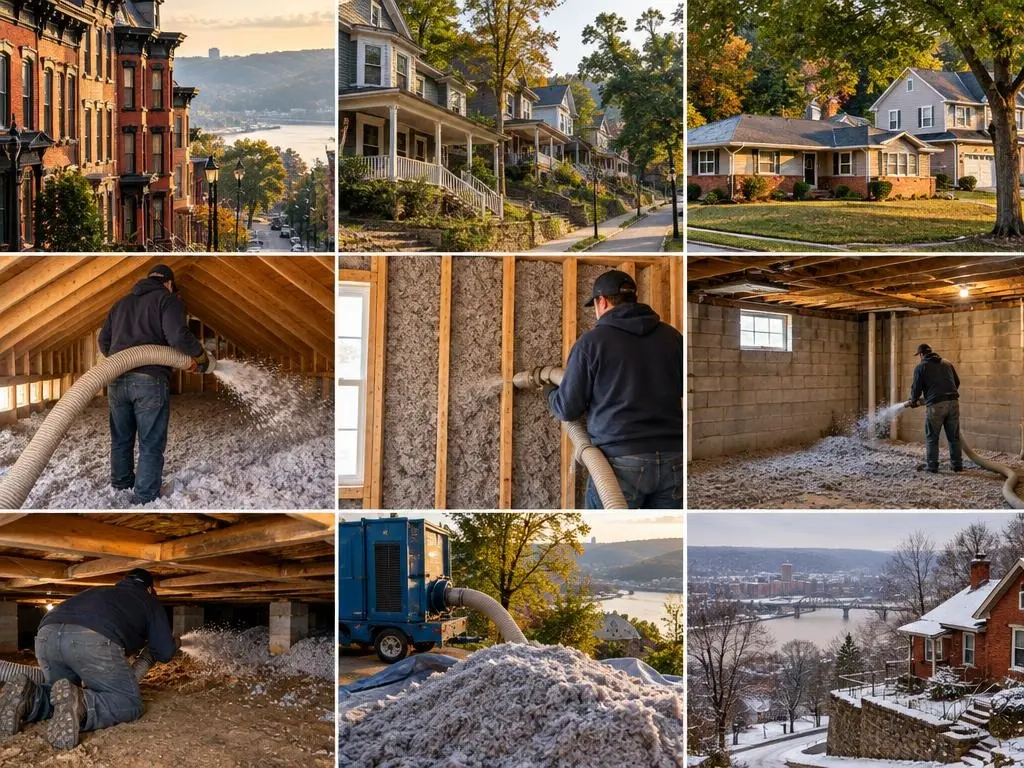
The rim joist is our most frequent foam job. It circles the whole house on top of the foundation, it is often bare wood with a scrap of fiberglass pushed in, and it lets outside air into the basement or crawl space all year. A couple of inches of closed-cell seals and insulates it in one pass.
Older city homes bring other targets. Balloon-framed houses can have wall cavities that run straight from the basement to the attic, acting like chimneys for warm air; foam at the top and bottom of those cavities shuts them down. Story-and-a-half Cape Cods and bungalows lose heat through knee walls and the slivers of attic behind them. Additions and sunrooms built on piers often have floors with little more than a thin batt. Newer homes in the northern suburbs usually need foam over the garage, at cantilevered floors and in the attic over bonus rooms.
Where foam is the wrong answer
Foam does not fix a leak. If a roof, gutter or plumbing leak is wetting the framing, it gets repaired first, or the foam simply hides rot. On a big, open attic floor foam is seldom the economical choice; sealing the bypasses and blowing in loose fill gets similar results for less. Foam should not go over knob-and-tube wiring or vermiculite that may contain asbestos until those have been checked. And on solid brick walls, common in the city's oldest neighborhoods, foam on the interior can change how the masonry dries, so we look at the wall before recommending anything.
Prep, curing and getting back in
Spraying is quick; preparation takes longer. We cover floors and furniture, mask windows and outlets, and set up fans to move air out of the work area. HomeGuide advises staying out for 24 hours or more while foam cures, so most households plan a night away. Foam also needs the surface and the material inside a working temperature range, which shapes when we schedule unheated crawl spaces in winter and attics in midsummer. Once cured, foam does not settle or sag; the thickness we leave is the thickness you keep.
Tell us which spaces you are thinking about and what you have noticed, such as a hot upstairs, cold floors or a musty crawl space. We will look, explain where foam earns its cost, and send a written price. Get a free estimate
Where We Spray Foam
The areas we foam most often and the foam we usually pick for each.
Closed-cell spray foam
Dense foam rated around R-5 to R-7 per inch (HomeGuide) that slows vapor; our pick for crawl space and basement walls, rim joists and roof decks.
Open-cell spray foam
Light foam around R-3.5 to R-3.7 per inch that seals air and quiets sound; used in interior walls and above-grade cavities with a moisture plan.
Rim joists and band boards
Foam on the wood band that sits on the foundation, closing the draft along the whole perimeter.
Knee walls and half-story attics
Sealing the short walls and attic floors around upstairs rooms in Cape Cods and bungalows.
Vaulted ceilings and roof decks
Closed-cell under the roof deck where there is no attic or no space for vent channels.
Open walls in remodels and additions
Stud bays sprayed while the walls are open, sized to the Ohio wall target.
Floors over garages and porches
Foam in the framing under bonus rooms and cantilevers to seal out cold air and garage fumes.

National Spray Foam Insulation Cost Ranges
| Job | Range and source |
|---|---|
| Spray foam, installed | $1.50 to $5.00 per sq ft (HomeGuide) |
| Open-cell / closed-cell | $1.50 to $3.50 / $3.00 to $5.00 per sq ft (HomeGuide) |
| About 1,000 sq ft | $1,500 to $5,000 (HomeGuide); $3,150 to $7,500 existing home (Fixr) |
| Existing walls / new construction | $3.15 to $7.50 / $2.75 to $6.50 per sq ft (Fixr) |
| All exterior walls | $4,000 to $10,000 (HomeGuide) |
| Whole house | $8,000 to $20,000 (HomeGuide); $10,000 to $30,000 (Fixr) |
| Typical job minimum | $1,000 to $2,000+ (HomeGuide) |
Figures come from HomeGuide's 2026 spray foam guide and Fixr's 2025 guide, and they are national, not Cincinnati-specific. Foam type, thickness, access and prep work move the total, and small jobs often land on a minimum. You pay the amount written on the estimate we hand you, not a number from a chart.
How a Spray Foam Job Runs
1. Walk-through
We inspect each space, check for leaks, damp wood, old wiring and vermiculite, and take measurements.
2. Written quote
Every area lists the foam, the thickness, the R-value and the price.
3. Prep and protection
We cover, mask and set up ventilation, and confirm the space is in a workable temperature range.
4. Spraying
Foam goes on in passes to the planned thickness and is trimmed where needed.
5. Cleanup and re-entry
We clean up, walk you through the work and tell you when the space can be used.

Why Choose Us for Spray Foam Insulation
Foam only where it pays
If blown-in or simple air sealing handles part of the house for less, we tell you.
Thickness on paper
The quote names thickness and R-value so you can compare it against other bids.
Hidden problems flagged
Leaks, old wiring and suspect vermiculite are pointed out before anything gets covered.
Spray Foam Insulation Questions
Is closed-cell foam worth the extra money?
For crawl space and basement walls, rim joists and roof decks without an attic, usually yes, because it slows vapor and packs more R-value into each inch. In interior walls or open above-grade cavities, open-cell often does the job for less. Where either would work, we price both.
Who manufactures spray foam insulation?
Several chemical companies make professional two-part foam systems, and installers buy from them through distributors. What matters more for your house is which type is used (open or closed cell), the thickness, and whether the surface was prepared and the temperature was right when it was sprayed.
Can spray foam stop a water leak?
No. Closed-cell foam resists water and slows vapor, but it is not waterproofing and will not stop a leak through a roof, wall or foundation. Leaks get fixed before any foam goes on.
Will spray foam make my house too tight?
A tighter house is the goal, but fuel-burning appliances still need combustion air and the house still needs ventilation. We look at the furnace, water heater and bath fans and tell you if anything should be checked by an HVAC contractor.
Does spray foam smell after it cures?
There is an odor during spraying and curing, which is why the household stays out for 24 hours or more as HomeGuide advises and why we ventilate the space. Once cured, foam should not keep smelling; tell us if it does.
Spray Foam Insulation Service Areas
- Spray Foam Insulation in Cincinnati, OH
- Spray Foam Insulation in Norwood, OH
- Spray Foam Insulation in Blue Ash, OH
- Spray Foam Insulation in Madeira, OH
- Spray Foam Insulation in Wyoming, OH
- Spray Foam Insulation in Indian Hill, OH
- Spray Foam Insulation in Anderson Township, OH
- Spray Foam Insulation in Green Township, OH
- Spray Foam Insulation in Delhi Township, OH
- Spray Foam Insulation in Colerain Township, OH
- Spray Foam Insulation in Sharonville, OH
- Spray Foam Insulation in Loveland, OH
- Spray Foam Insulation in Milford, OH
- Spray Foam Insulation in Mason, OH
- Spray Foam Insulation in West Chester Township, OH
- Spray Foam Insulation in Fairfield, OH
- Spray Foam Insulation in Hamilton, OH
- Spray Foam Insulation in Covington, KY
- Spray Foam Insulation in Florence, KY
- Spray Foam Insulation in Fort Thomas, KY
Get a Spray Foam Insulation Estimate
Name the spaces and what bothers you about them. We will look and send a written foam plan with prices.